> ## Documentation Index
> Fetch the complete documentation index at: https://dragonwingdocs-staging.qualcomm.com/llms.txt
> Use this file to discover all available pages before exploring further.
# QIM SDK Introduction
The Qualcomm® Intelligent Multimedia SDK (QIM SDK) is a hardware-accelerated multimedia and AI framework for building intelligent edge applications on Qualcomm® platforms. It provides reusable pipeline components, optimized plugins, and reference applications for use cases such as smart cameras, robotics, drones, home appliances, AI appliances, and connected devices.
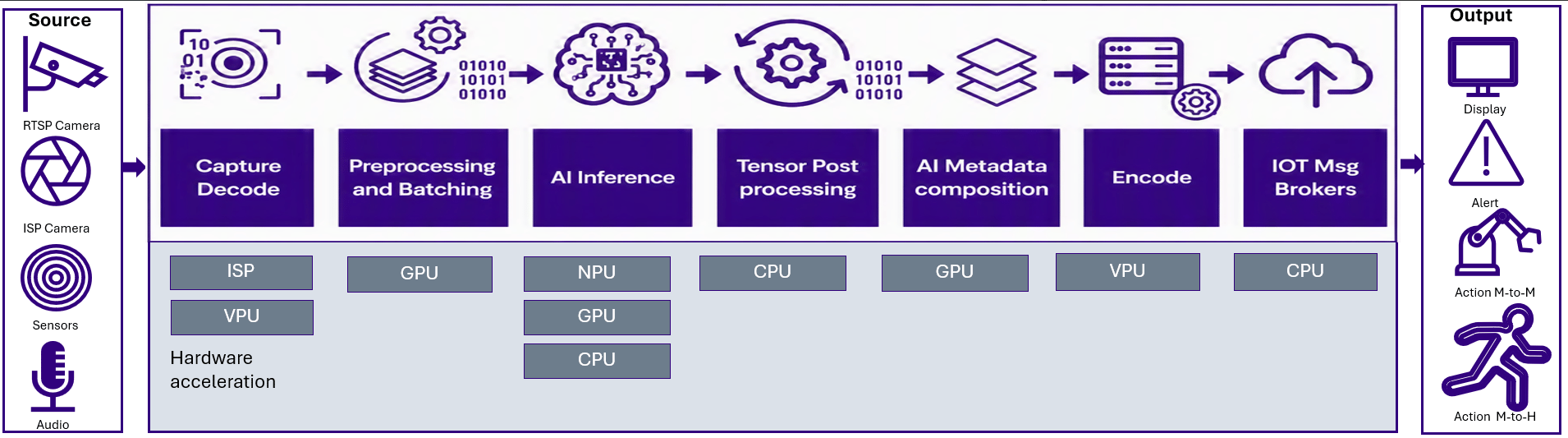 QIM SDK combines camera capture, media processing, AI preprocessing, AI inference, post-processing, rendering, encoding, and streaming in a single application workflow. You can start with a ready-to-run sample, adapt a reference pipeline, or build a custom application using the programming model that best fits your use case.
This page provides a workflow-level overview for the AI Developer Workflow. For complete SDK reference material, including installation, plugin catalogs, App Builder APIs, sample pipelines, and reference applications, see the [QIM SDK documentation](https://imsdkdocs.qualcomm.com/index).
If you are not ready to write code, first run a prebuilt application. See [Run a Qualcomm IM SDK sample application](../topic/sample-app-evk) to validate a working AI pipeline on your device before you start building.
## Why use QIM SDK?
QIM SDK reduces the effort required to build optimized AI and multimedia applications on Qualcomm platforms. It provides the following benefits:
Run capture, preprocessing, inference, post-processing, rendering, encoding, and streaming in one GStreamer-based workflow instead of stitching together separate applications.
Use Qualcomm CPU, GPU, NPU/HTP, camera ISP, video, display, and DSP engines so each pipeline stage runs on the hardware block best suited for that task.
Pass frames between compatible pipeline stages as DMA-buf handles to reduce CPU copies, memory bandwidth, and latency.
Run resize, color conversion, tensor layout conversion, and overlay rendering on the Adreno GPU so the CPU remains available for application logic.
Choose LiteRT/TFLite, ONNX, Qualcomm AI Engine Direct, or SNPE runtime paths based on model format, performance goals, and deployment requirements.
Start with pre-trained and optimized models from Qualcomm AI Hub and integrate them into QIM SDK reference pipelines.
## How zero-copy improves performance
Traditional media pipelines often copy frames between stages. These copies increase CPU usage, memory traffic, and end-to-end latency. QIM SDK avoids unnecessary copies by passing frames as shared DMA-buf handles when all plugins in the path support zero-copy operation.
```mermaid theme={null}
%%{init: {"themeVariables": {"fontSize": "13px"}, "flowchart": {"htmlLabels": true, "nodeSpacing": 18, "rankSpacing": 26, "curve": "basis", "padding": 6}}}%%
flowchart TB
subgraph T["❌ Traditional pipeline — the frame is copied at every stage"]
direction LR
T1["Capture
QIM SDK combines camera capture, media processing, AI preprocessing, AI inference, post-processing, rendering, encoding, and streaming in a single application workflow. You can start with a ready-to-run sample, adapt a reference pipeline, or build a custom application using the programming model that best fits your use case.
This page provides a workflow-level overview for the AI Developer Workflow. For complete SDK reference material, including installation, plugin catalogs, App Builder APIs, sample pipelines, and reference applications, see the [QIM SDK documentation](https://imsdkdocs.qualcomm.com/index).
If you are not ready to write code, first run a prebuilt application. See [Run a Qualcomm IM SDK sample application](../topic/sample-app-evk) to validate a working AI pipeline on your device before you start building.
## Why use QIM SDK?
QIM SDK reduces the effort required to build optimized AI and multimedia applications on Qualcomm platforms. It provides the following benefits:
Run capture, preprocessing, inference, post-processing, rendering, encoding, and streaming in one GStreamer-based workflow instead of stitching together separate applications.
Use Qualcomm CPU, GPU, NPU/HTP, camera ISP, video, display, and DSP engines so each pipeline stage runs on the hardware block best suited for that task.
Pass frames between compatible pipeline stages as DMA-buf handles to reduce CPU copies, memory bandwidth, and latency.
Run resize, color conversion, tensor layout conversion, and overlay rendering on the Adreno GPU so the CPU remains available for application logic.
Choose LiteRT/TFLite, ONNX, Qualcomm AI Engine Direct, or SNPE runtime paths based on model format, performance goals, and deployment requirements.
Start with pre-trained and optimized models from Qualcomm AI Hub and integrate them into QIM SDK reference pipelines.
## How zero-copy improves performance
Traditional media pipelines often copy frames between stages. These copies increase CPU usage, memory traffic, and end-to-end latency. QIM SDK avoids unnecessary copies by passing frames as shared DMA-buf handles when all plugins in the path support zero-copy operation.
```mermaid theme={null}
%%{init: {"themeVariables": {"fontSize": "13px"}, "flowchart": {"htmlLabels": true, "nodeSpacing": 18, "rankSpacing": 26, "curve": "basis", "padding": 6}}}%%
flowchart TB
subgraph T["❌ Traditional pipeline — the frame is copied at every stage"]
direction LR
T1["Capture
buffer 1"] -->|"memcpy"| T2["Preprocess
buffer 2"]
T2 -->|"memcpy"| T3["Inference
buffer 3"]
T3 -->|"memcpy"| T4["Display
buffer 4"]
T4 --- TC["4 buffers · high memory traffic
CPU spent moving data · added latency"]
end
subgraph Q["✅ QIM SDK — one buffer, shared by handle"]
direction LR
Q1["Capture
ISP"] -->|"DMA-buf handle"| Q2["Preprocess
GPU"]
Q2 -->|"DMA-buf handle"| Q3["Inference
NPU / HTP"]
Q3 -->|"DMA-buf handle"| Q4["Display
Display"]
Q4 --- QC["1 shared buffer · low memory traffic
CPU free for application logic · lower latency"]
end
T ~~~ Q
classDef copy fill:#5B6770,stroke:#5B6770,color:#ffffff,stroke-width:2px;
classDef zc fill:#31017D,stroke:#31017D,color:#ffffff,stroke-width:2px;
classDef notec fill:#ffffff,stroke:#5B6770,color:#5B6770,stroke-dasharray:4 3;
classDef notez fill:#ffffff,stroke:#31017D,color:#31017D,stroke-dasharray:4 3;
class T1,T2,T3,T4 copy;
class Q1,Q2,Q3,Q4 zc;
class TC notec;
class QC notez;
```
* Camera ISP, GPU, NPU/HTP, video, and display blocks can operate on shared buffers without repeated CPU memory copies.
* GStreamer allocation negotiation lets compatible plugins agree on DMA-buf allocation and import behavior.
* The result is lower memory bandwidth, reduced CPU load, and improved latency, especially for high-resolution, multi-stream, and real-time workloads.
Zero-copy works only when **every** plugin in the path supports it. If you add an element that requires CPU-mapped buffers, the pipeline falls back to copying at that point. Consider this when adding custom or third-party elements to an accelerated pipeline.
## GPU-accelerated preprocessing and post-processing
AI inference performs best when the NPU/HTP receives correctly formatted tensors without interruption. QIM SDK uses the Adreno GPU for data-shaping and overlay work, reducing CPU load and helping keep the inference path efficient.
```mermaid theme={null}
%%{init: {"themeVariables": {"fontSize": "13px"}, "flowchart": {"htmlLabels": true, "nodeSpacing": 18, "rankSpacing": 26, "curve": "basis", "padding": 6}}}%%
flowchart LR
F["Video frame
NV12 · any resolution"]
PRE["qtimlvconverter
GPU
Color convert
Resize · tensor layout"]
INF["Inference
NPU / HTP
Run the model"]
POST["qtimlpostprocess
Decode output tensors
into ML metadata"]
OVL["qtivoverlay
GPU
Draw boxes · labels
masks on the frame"]
OUT["Annotated frame
display · record · stream"]
F --> PRE -->|"input tensor"| INF -->|"output tensors"| POST -->|"metadata"| OVL --> OUT
classDef gpu fill:#31017D,stroke:#31017D,color:#ffffff,stroke-width:2px;
classDef npu fill:#3253DC,stroke:#3253DC,color:#ffffff,stroke-width:2px;
classDef io fill:#5B6770,stroke:#5B6770,color:#ffffff,stroke-width:2px;
class PRE,OVL gpu;
class INF,POST npu;
class F,OUT io;
```
* **Preprocessing:** `qtimlvconverter` performs color-space conversion, resizing, and tensor-layout transforms on the GPU to produce the input tensor required by the model.
* **Post-processing:** `qtimlpostprocess` decodes model output tensors into structured ML metadata such as bounding boxes, labels, and masks. `qtivoverlay` then renders that metadata on the frame using the GPU.
## Next steps
Continue to the development workflow to review the important QIM SDK components, the application development workflow, and the post-processing modules and supported use cases.
## Related information
* [Run inference](../map/use-available-frameworks-and-runtimes) — compare QIM SDK with other runtime and integration paths.
* [Prepare your model](../map/compile-and-optimize-model) — convert, quantize, or fine-tune a model before integrating it.
* [Develop an AI application using QAIRT C++ APIs](../topic/develop-your-own-application-qairt-cpp) — use the lower-level API path when your application is not a multimedia pipeline.
* [QIM SDK documentation](https://imsdkdocs.qualcomm.com/index) — the complete SDK reference.