> ## Documentation Index
> Fetch the complete documentation index at: https://dragonwingdocs-staging.qualcomm.com/llms.txt
> Use this file to discover all available pages before exploring further.
# QIM SDK Introduction
The Qualcomm® Intelligent Multimedia SDK (QIM SDK) is a hardware-accelerated multimedia and AI framework for building intelligent edge applications on Qualcomm® platforms. It provides reusable pipeline components, optimized plugins, and reference applications for use cases such as smart cameras, robotics, drones, home appliances, AI appliances, and connected devices.
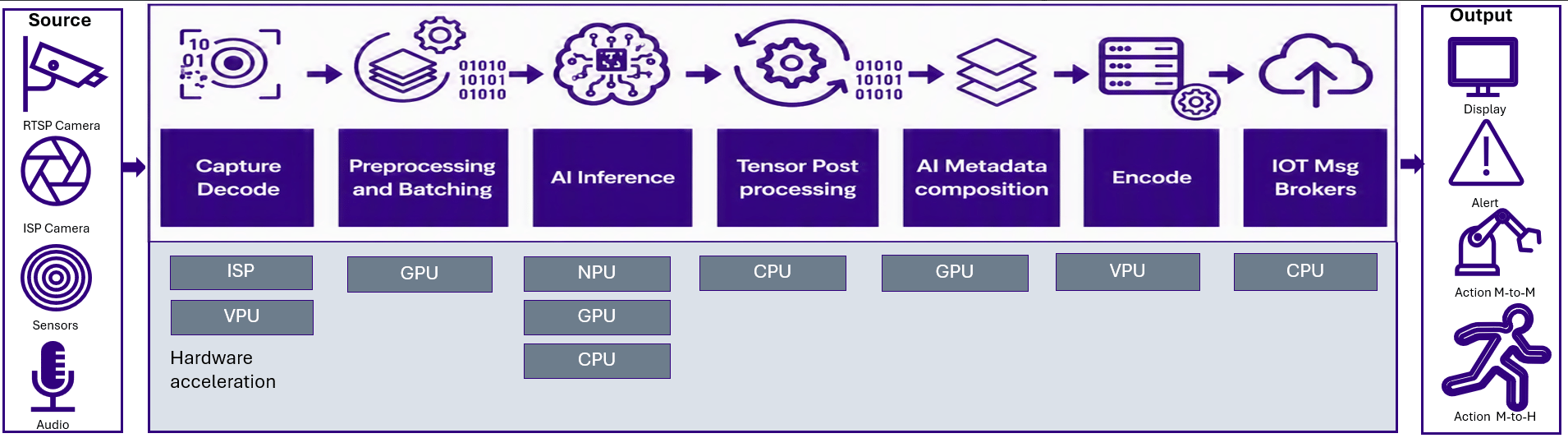 QIM SDK combines camera capture, media processing, AI preprocessing, AI inference, post-processing, rendering, encoding, and streaming in a single application workflow. You can start with a ready-to-run sample, adapt a reference pipeline, or build a custom application using the programming model that best fits your use case.
This page provides a workflow-level overview for the AI Developer Workflow. For complete SDK reference material, including installation, plugin catalogs, App Builder APIs, sample pipelines, and reference applications, see **[Discover SDKs → IM SDKs](https://imsdkdocs.qualcomm.com)**.
If you are not ready to write code, first run a prebuilt application. See [Run a Qualcomm IM SDK sample application](../topic/sample-app-evk) to validate a working AI pipeline on your device before you start building.
## Why use QIM SDK
QIM SDK reduces the effort required to build optimized AI and multimedia applications on Qualcomm platforms. It provides the following benefits:
Capture, preprocess, inference, post-process, and render all live in a single GStreamer pipeline, not separate apps glued together.
Plugins natively use the Qualcomm CPU, GPU, NPU (HTP), camera ISP, video (VPU), and DSP, so each stage runs on the right engine.
Frames move through the pipeline as DMA-buf handles, so the same buffer is shared across ISP, GPU, and NPU with no CPU copies.
Resize, color conversion, tensor layout, and overlay rendering run on the Adreno GPU, keeping the CPU free and inference fed.
Run models through LiteRT/TFLite, ONNX, Qualcomm AI Engine Direct (QNN), or SNPE. Choose per model without rewriting the pipeline.
Download pre-trained, quantized models from [Qualcomm AI Hub](https://aihub.qualcomm.com/) and run them as-is in a reference pipeline.
## How an QIM SDK pipeline works
A typical vision-AI pipeline has five stages. The QIM SDK accelerates the highlighted (⚡) stages on dedicated hardware and passes frames between them as zero-copy DMA-buf handles.
```mermaid theme={null}
flowchart LR
classDef gpu fill:#31017D,color:#fff,stroke:#31017D
classDef npu fill:#3253DC,color:#fff,stroke:#3253DC
classDef io fill:#5B6770,color:#fff,stroke:#5B6770
Cam["Data source
QIM SDK combines camera capture, media processing, AI preprocessing, AI inference, post-processing, rendering, encoding, and streaming in a single application workflow. You can start with a ready-to-run sample, adapt a reference pipeline, or build a custom application using the programming model that best fits your use case.
This page provides a workflow-level overview for the AI Developer Workflow. For complete SDK reference material, including installation, plugin catalogs, App Builder APIs, sample pipelines, and reference applications, see **[Discover SDKs → IM SDKs](https://imsdkdocs.qualcomm.com)**.
If you are not ready to write code, first run a prebuilt application. See [Run a Qualcomm IM SDK sample application](../topic/sample-app-evk) to validate a working AI pipeline on your device before you start building.
## Why use QIM SDK
QIM SDK reduces the effort required to build optimized AI and multimedia applications on Qualcomm platforms. It provides the following benefits:
Capture, preprocess, inference, post-process, and render all live in a single GStreamer pipeline, not separate apps glued together.
Plugins natively use the Qualcomm CPU, GPU, NPU (HTP), camera ISP, video (VPU), and DSP, so each stage runs on the right engine.
Frames move through the pipeline as DMA-buf handles, so the same buffer is shared across ISP, GPU, and NPU with no CPU copies.
Resize, color conversion, tensor layout, and overlay rendering run on the Adreno GPU, keeping the CPU free and inference fed.
Run models through LiteRT/TFLite, ONNX, Qualcomm AI Engine Direct (QNN), or SNPE. Choose per model without rewriting the pipeline.
Download pre-trained, quantized models from [Qualcomm AI Hub](https://aihub.qualcomm.com/) and run them as-is in a reference pipeline.
## How an QIM SDK pipeline works
A typical vision-AI pipeline has five stages. The QIM SDK accelerates the highlighted (⚡) stages on dedicated hardware and passes frames between them as zero-copy DMA-buf handles.
```mermaid theme={null}
flowchart LR
classDef gpu fill:#31017D,color:#fff,stroke:#31017D
classDef npu fill:#3253DC,color:#fff,stroke:#3253DC
classDef io fill:#5B6770,color:#fff,stroke:#5B6770
Cam["Data source
qticamsrc · v4l2 decode · RTSP/file"]:::io
Pre["⚡ Preprocessing: GPU
qtimlvconverter
resize · color convert · tensor layout"]:::gpu
Inf["⚡ Inference: NPU/HTP
qtimltflite · qtimlqnn
qtimlonnx · qtimlsnpe"]:::npu
Post["⚡ Post-processing: GPU
qtimlpostprocess + qtivoverlay"]:::gpu
Out["Use AI metadata
display · RTSP/WebRTC · MQTT/Kafka · actions"]:::io
Cam -->|"DMA-buf (zero-copy)"| Pre -->|"DMA-buf"| Inf -->|"tensors"| Post -->|"DMA-buf"| Out
```
| Stage | QIM SDK plugin(s) | Hardware engine |
| - | - | - |
| Capture / decode | `qticamsrc`, `v4l2h264dec` / `v4l2h265dec` | Camera ISP, Video (VPU) |
| Preprocessing | `qtimlvconverter` | GPU (Adreno) |
| Inference | `qtimltflite` (LiteRT), `qtimlqnn` (AI Engine Direct / QNN), `qtimlonnx` (ONNX), `qtimlsnpe` (SNPE) | NPU/HTP (Hexagon), CPU, GPU |
| Post-processing | `qtimlpostprocess` | CPU / GPU |
| Overlay / compose / encode | `qtivoverlay`, `qtivcomposer`, `v4l2h264enc` | GPU, Video (VPU) |
For a stage-by-stage guide to building these pipelines, see [Building AI pipelines](https://imsdkdocs.qualcomm.com/qimsdk-overview/sdkoverview) and the [plugin reference](https://imsdkdocs.qualcomm.com/plugin-reference/introduction) in Discover SDKs.
### How zero-copy improves performance
In a naive pipeline, every stage copies the frame into its own buffer, burning memory bandwidth and CPU cycles, and adding latency. The IM SDK instead keeps **one frame buffer moving** across decode → preprocess → inference → overlay → encode as a shared **DMA-buf** handle:
* The camera ISP writes a frame once; the GPU and NPU read the **same physical buffer**, with no `memcpy` between engines.
* Plugins negotiate DMA-buf allocation automatically through GStreamer's allocation-query mechanism; zero-copy is enabled when every stage in the pipeline supports it (for example, `capture-io-mode=dmabuf` / `output-io-mode=dmabuf-import` on decode/encode elements).
* The result is **lower memory traffic, lower CPU load, and lower end-to-end latency**, which matters most for high-resolution and multi-stream workloads.
### Pre- and post-processing on the GPU
Inference on the NPU is only fast if the NPU is never waiting on the CPU. The IM SDK runs the data-shaping work on the Adreno GPU:
* **Preprocessing**: `qtimlvconverter` performs color-space conversion and tensor-layout transforms directly on the GPU, producing the exact tensor the model expects without a CPU bottleneck before inference.
* **Post-processing**: `qtimlpostprocess` decodes the model's output tensors into structured metadata (bounding boxes, labels, masks), and `qtivoverlay` draws that metadata back onto the frame in-place on the GPU.
## Next steps
Set up the Qualcomm IM SDK extensible SDK (eSDK) and download the source code to develop AI/ML application and plugin code.
Choose the right Qualcomm SDK path to deploy a custom AI model in an application using the Qualcomm IM SDK or the Qualcomm AI Runtime SDK.
Add custom model postprocessing support to a Qualcomm IM SDK pipeline using the qtimlpostprocess plugin.