

Debug the high-definition multimedia interface (HDMI) display
Set switch SW7 to OFF as described in IQ-615 HDMI setup, then use the connector map and checks below.Connect to the target through SSH and run target commands from the root shell. For instructions, see Sign in using SSH.
HDMI-A-1.
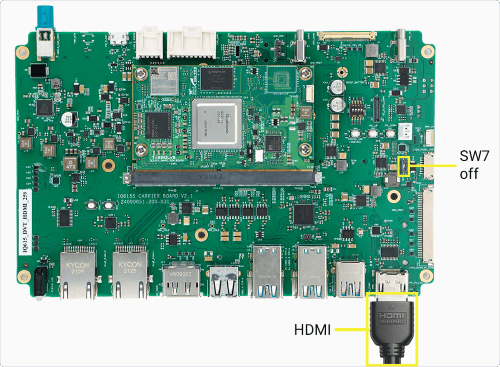
Figure: IQ-615 HDMI connection
1. Identify the connector
Run the following command:
This lists the HDMI connector, its DRM ID, and its connection state.
Reference output
2. Check connector status and modes
Run the following command:
This reports whether HDMI is connected. The expected result is
connected.Run the following command:This lists the modes reported by the connected monitor.If HDMI is
disconnected or reports no modes, check the cable, monitor power, and selected HDMI input. DRM object IDs and card numbers can vary by build.3. Check the active DRM state
If Run the following command:
debugfs is not mounted, run the following command:This makes DRM state and interface debug data available.Run the following command:
This shows the HDMI encoder, CRTC, mode, and plane.
Reference output
This shows the kernel DRM connector, encoder, CRTC, and plane state.For
HDMI-A-1, confirm one active display pipeline:status: connected- A nonzero CRTC ID
active=yesfor that CRTC- A plane whose
crtcfield matches that CRTC ID
Restore Weston after testing a display mode.To test a different mode, follow Run DRM modetest, then Relaunch Weston before returning to Weston tests.
4. Check interface signals
Run the following command:
This prints the available DSI pixel-clock rates used by the HDMI bridge in Hz.Compare the rate with the active CRTC pixel clock, which
modetest reports in kHz. If the clock path is absent, continue with the DRM state and kernel log checks.5. Check current-boot kernel messages and live display events
Run the following command:To capture display events while reproducing the issue, run the following command:
This shows bridge, EDID, DSI, and DRM messages from the current boot only. If it returns no lines, capture live data while reproducing the issue.
Reference output
This follows new Weston and kernel messages. Run it without
-k so the output includes compositor connector changes and output enablement. Reproduce the issue, then press Ctrl+C.Look for connector-state changes, EDID or mode detection, output enablement, and driver errors. Compare the relevant messages with the connector status and active DRM state.EDID or I2C errors point to the monitor, cable, or bridge.6. Interpret the result
Verify the Weston service before checking the output layout.Run the following command:The expected result is
active. If the service is not active, Relaunch Weston before continuing.7. Check Weston and the output layout
Run the following command:
This shows the latest Weston messages from the current boot.Run the following command if Weston is active but the display is blank:
This lists the available Wayland socket names.Run the following command after replacing the placeholders:
Compare the Weston output with DRM state.This prints Weston output information. Find the selected display output and compare it with the DRM connector and CRTC state. If Weston is inactive, Relaunch Weston before continuing.