> ## Documentation Index
> Fetch the complete documentation index at: https://dragonwingdocs-staging.qualcomm.com/llms.txt
> Use this file to discover all available pages before exploring further.
# Thermal architecture
The thermal architecture shows how the Qualcomm Linux thermal framework interacts with temperature sensors (Tsens) hardware, cooling map interfaces, and user space clients.
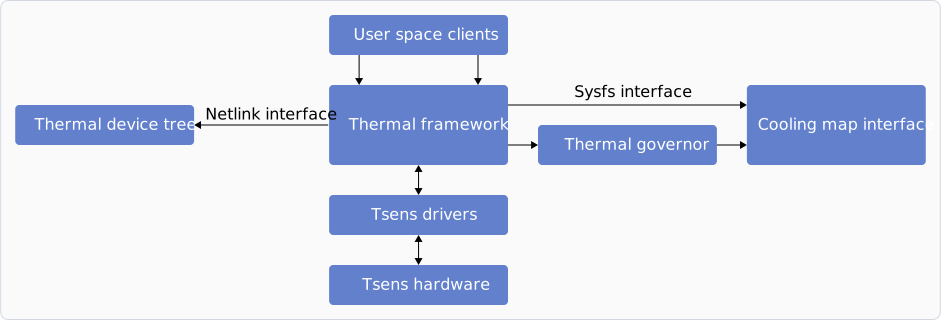 **Figure: Thermal architecture**
**Table: Description of the components of thermal architecture**
| Components of Thermal Architecture | Description |
| ---------------------------------- | ----------------------------------------------------------------------------------------------------------------------------------------------------------------------------------------------------------------------------------------------------------------------------------------------------------------------------------------------------------------------------------------------------------------------------------------------------------- |
| Thermal device tree |
**Figure: Thermal architecture**
**Table: Description of the components of thermal architecture**
| Components of Thermal Architecture | Description |
| ---------------------------------- | ----------------------------------------------------------------------------------------------------------------------------------------------------------------------------------------------------------------------------------------------------------------------------------------------------------------------------------------------------------------------------------------------------------------------------------------------------------- |
| Thermal device tree | - A thermal device tree consists of various thermal zones.
- A thermal zone is configured for every Tsens.
- Each thermal zone consists of sensor hardware information, different levels of thermal thresholds, and their respective cooling actions.
- All rules for a thermal zone are defined in the device tree.
|
| Thermal framework | The thermal framework parses the thermal zone rules from the device tree and configures Tsens hardware to generate interrupts when temperature crosses the threshold. |
| Thermal governor | - The thermal governor is a temperature monitor algorithm that controls the temperature of a thermal zone.
- It mitigates the cooling devices associated with the zone and keeps the temperature within the limit.
- On receiving an interrupt notification from Tsens hardware, the thermal framework uses a stepwise thermal governor to communicate the cooling actions to the cooling map interface (CPU frequency driver).
|
| Cooling map interface | - A cooling map interface is a collection of devices that can be throttled to reduce the temperature of Qualcomm Linux.
- Every trip instance of the thermal zone is associated with a cooling device.
- The thermal core framework aggregates all the cooling device instance requests and places the aggregated requests to the cooling device.
|
| User space clients | User space clients use the following interfaces to communicate with the thermal framework:
- The `sysfs` interface is used to read the temperature of Tsens and kernel trip information.
- The `Netlink` interface gets information on Tsens temperature notifications.
|
## Next steps
* [Thermal mitigation policies](thermal-mitigation-policies)